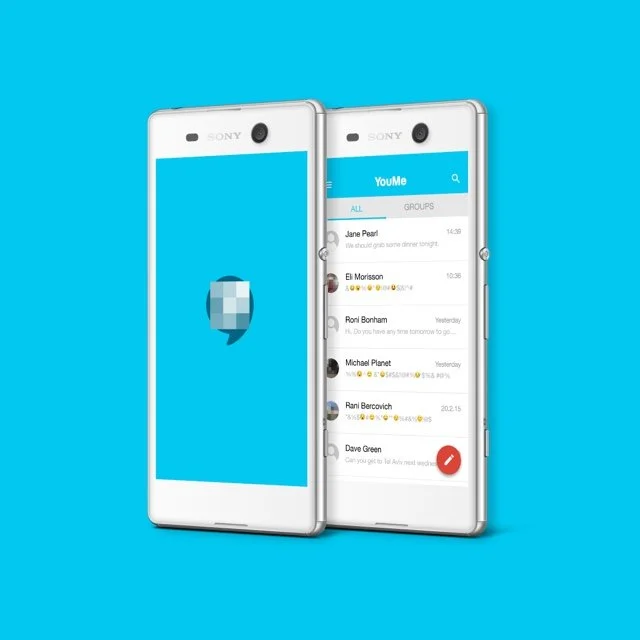


YouMe is a privacy-first social messaging app designed to restore control to the user. It empowers individuals to manage what they share, when, and with whom - redefining digital communication as intentional rather than impulsive.
I joined the founding team at the earliest stage, shaping the product from zero to MVP. As Lead Product Designer, I led everything from UX architecture and UI flows to branding and design systems. My focus was to design with restraint - crafting an experience that feels private, intimate, and emotionally intelligent in a saturated, noisy app landscape.
The Challenge. How do you build a messaging app that makes privacy feel effortless, not technical?
In an age of hyper-connectedness, YouMe’s goal was to give users space - to rethink what a message should feel like when you're not being watched, judged, or bombarded with noise.
The challenge was to design a product that felt: Secure, but simple. Private, but not isolated. Emotionally calming, yet feature-rich beneath the surface.
1. MVP with a Privacy-First Mindset.
Focused on core differentiators:
Granular chat-level privacy settings.
Timed messages and capture-blocking as defaults.
Swipe-based interactions with minimal UI footprint.
All decisions supported trust without overloading the user.
2. Designing for Trust and Ease.
Home screen and chats emphasized white space, control, and flow.
Toolbars adapted dynamically based on context and intent.
Settings reframed not as features, but as boundaries the user controls.
3. Scalable UX Architecture.
Modular settings designed for future group chat and voice support.
Tabs for “People,” “Media,” and “Settings” created a lightweight navigation structure.
Iconography and interaction models kept intentionally quiet and non-invasive.
4. Visual and Brand Identity.
Built around subtlety, calm, and confidence.
Cyan/gray palette, rounded typography, and low-contrast shadows.
Microinteractions that gently reinforce decision-making (e.g. message expiration confirmation).
The overall look was intentionally quiet—focusing the user on their relationships, not the app itself. White space, minimal contrast, and unobtrusive transitions made the app feel like a sanctuary from social noise.